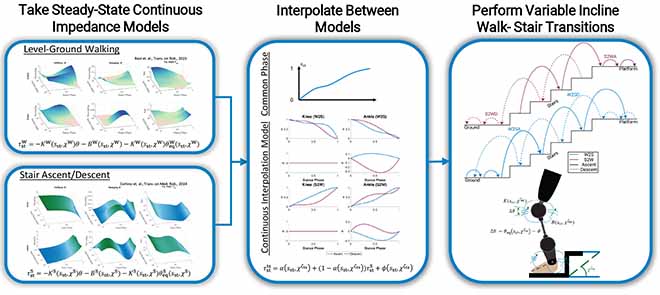
My Role
I contributed to a replay-constrained simulation framework for powered knee–ankle prosthesis controller personalization, connecting user-recorded gait data, MuJoCo prosthesis dynamics, and hardware validation.
A replay-constrained simulation framework for personalizing powered knee–ankle prosthesis controllers before testing them on real users. Instead of blindly tuning controller parameters on hardware, this workflow replays a user's recorded hip motion and ground-reaction interaction in MuJoCo, then searches for impedance strategies that are likely to transfer safely to the physical prosthesis.
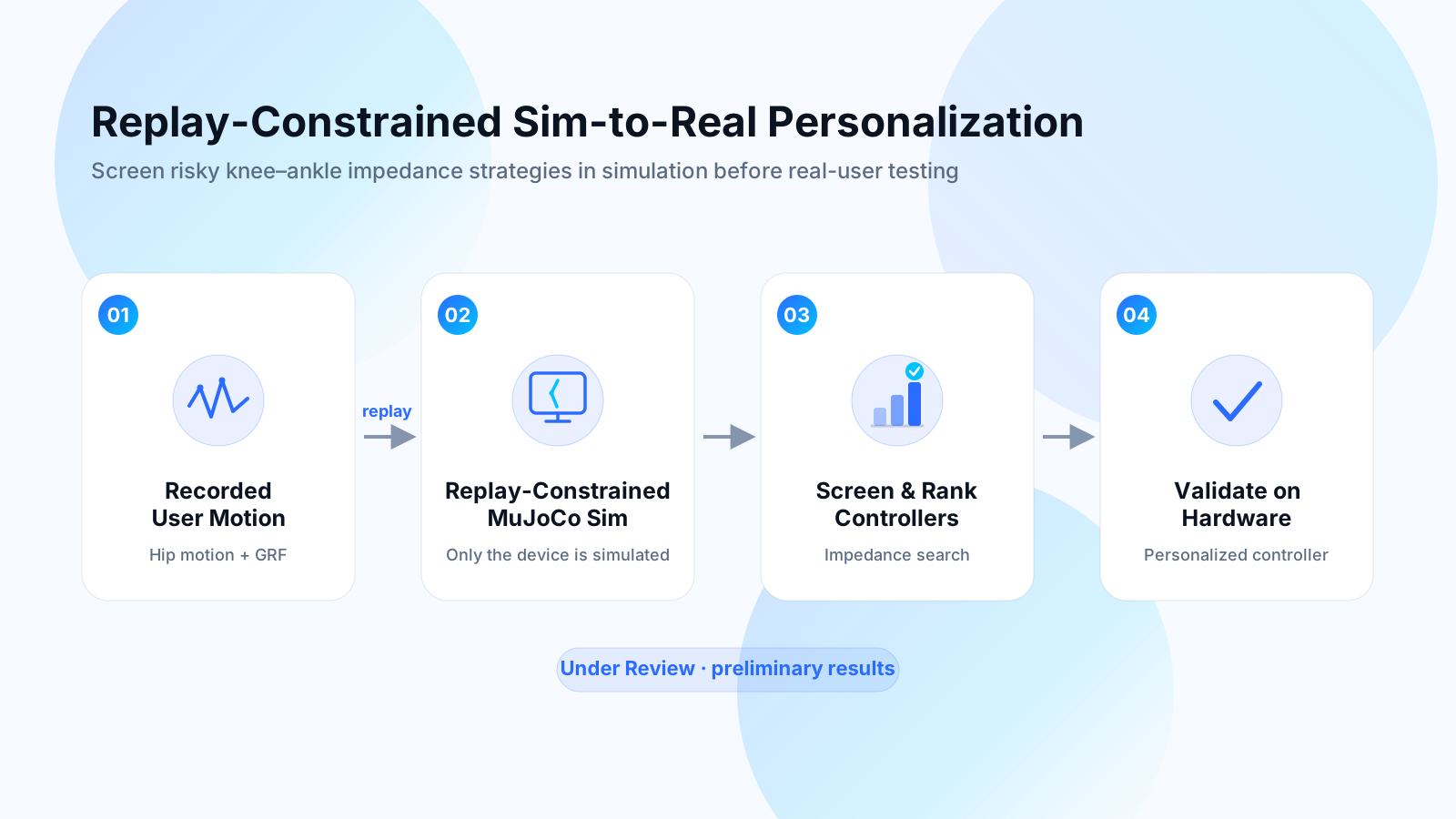
A prosthesis never walks alone — it is coupled to a human whose neuromuscular response is hard to model. Rather than simulate the person, this work replays recorded user motion while simulating the device, so risky high-dimensional impedance strategies can be screened and ranked before any real-user trial.
I contributed to a replay-constrained simulation framework for powered knee–ankle prosthesis controller personalization, connecting user-recorded gait data, MuJoCo prosthesis dynamics, and hardware validation.
Full-dimensional impedance personalization involves many coupled parameters across the knee and ankle joints, making direct hardware exploration slow, risky, and difficult to scale.
A replay-constrained MuJoCo framework that ranks personalized knee–ankle impedance controllers in simulation before real-user testing.
Ph.D. research conducted in the LocoLab at the University of Michigan, advised by Prof. Robert D. Gregg.