Research

Transitional Kinematics for Continuous Locomotion Control

A convex-combination kinematic model for powered knee-ankle prostheses that represents walking, stair movement, and the transitions between them in one continuous formulation. Plainly: this project built the motion model that later made smooth transition controllers possible.
IEEE TMRB 2022 Kinematic Modeling Continuous Transition Biomechanics Powered Prosthesis
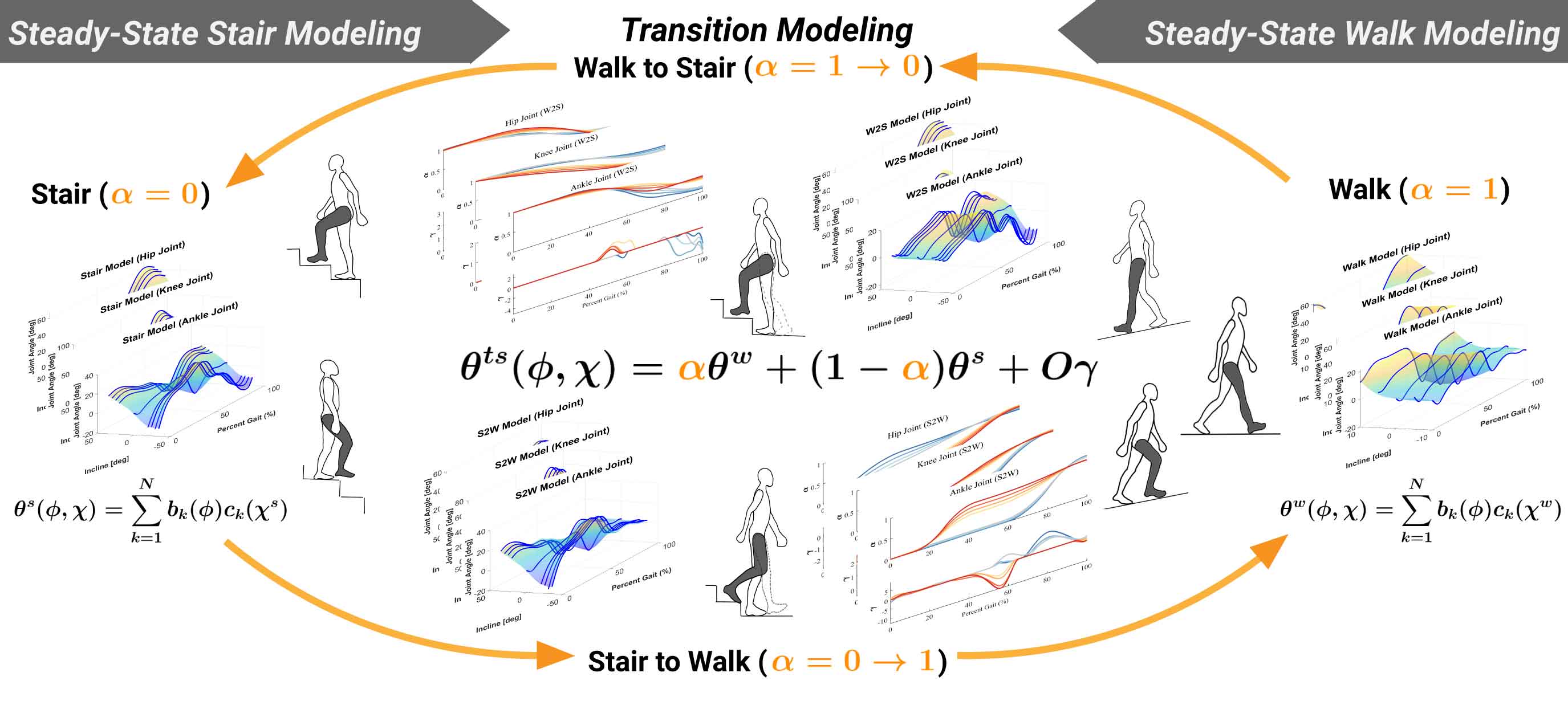
Conceptual formulation of the transitional kinematics model (TMRB 2022)
Transitional kinematics diagram linking steady-state stair and walk models through an alpha-blended transition formulation for walk-to-stair and stair-to-walk movement. Adapted from Cheng et al., IEEE TMRB 2022. © 2022 IEEE.
Problem & Contribution

The hardest moment in locomotion is often the transition itself; this work models walk–stair transitions as first-class movement, not just the gap between steady-state activities.

My Role

I developed the transitional kinematics formulation that modeled walking, stairs, and walk–stair transitions within a unified continuous framework.

Challenge

Discrete mode switching between walking and stairs is prone to timing errors and abrupt, uncomfortable transitions.

Contribution

A convex-combination movement model connecting walking, stair climbing, and walk–stair transitions.

Ph.D. research conducted in the LocoLab at the University of Michigan, advised by Prof. Robert D. Gregg.
Model Decomposition
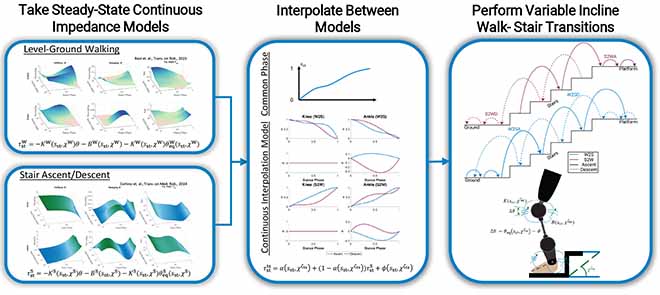
  1. 1 Steady-State Primitives Walking and stair kinematics are captured as reference behaviors.
  2. 2 Convex Combination A weighted blend of primitives represents the in-between motion.
  3. 3 Transition Kinematics One continuous, differentiable model spans walk, stair, and transition.
Evidence
Unified Walk / Stair / Transition Model
Modeling
Smooth, Differentiable Trajectories
Continuity
Foundation for Later Controllers
Basis
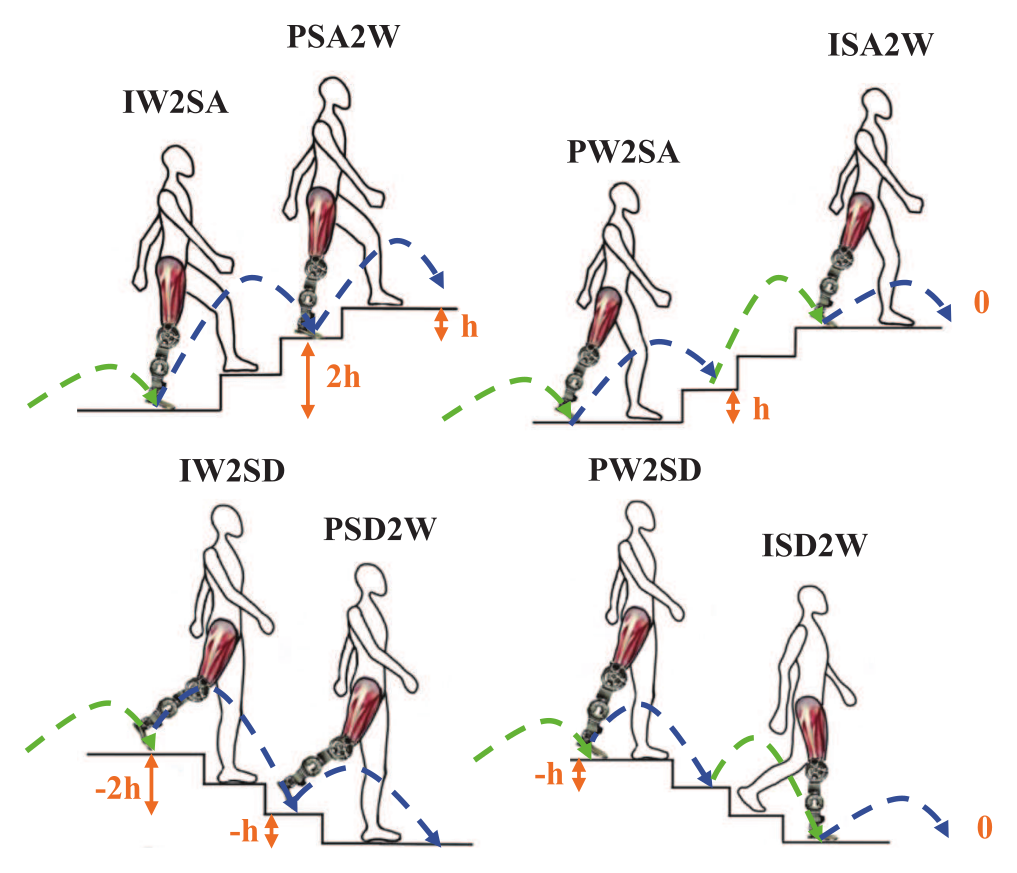
Continuous transition trajectory reconstruction demo (TMRB 2022)
Eight inter-leg walk-stair transition cases illustrated with prosthesis-user silhouettes, step-height offsets, and phase paths through the transition. Adapted from Cheng et al., IEEE TMRB 2022. © 2022 IEEE.
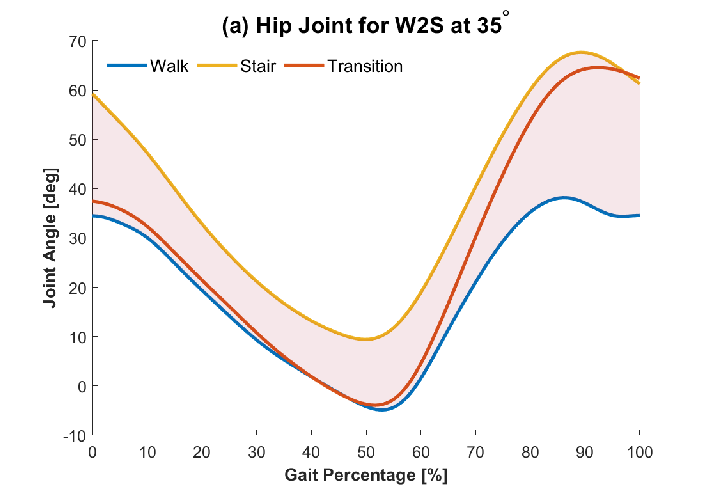
Transitional kinematics validation across gait modes (TMRB 2022)
Hip-joint trajectory plot for a walk-to-stair transition at 35 degrees, comparing walk, stair, and blended transition curves over gait percentage. Adapted from Cheng et al., IEEE TMRB 2022. © 2022 IEEE.

Technical Stack

Transitional Kinematics Convex Combination Continuous Locomotion Phase Variable Walk–Stair Transition Powered Prosthesis Platform
More Related Work
View all projects →